

Intel commits to shipping 7nm chips by 2022, an aggressive change of pace - johnsontithe1977
While Intel is struggling to drive out Intel Core processors fabricated on 10nm processes into production, the company dropped a thunderclap along Wednesday: Executives began talk about manufacturing 7nm chips in 2021.
During the company's investor meeting on Wednesday, newly appointed chief executive Curtsy Swan said that the society has begun planning for the 7nm manufacturing contemporaries as character of a strategy to recover manufacturing summons leadership. At the end of the daytime, though, Swan said that "product leadership is going to trump all," non process leadership.
That's an out-of-the-way statement to make from an enforcement up a chipmaker that has depended on manufacturing leadership for literally decades. In point of fact, Swan seemed prepared to suspend precedent for a more than practical approach. Instead of an "Intel Interior" predicated on CPUs, Swan said that Intel's market opportunity was now far large, and predicated on an "XPU" strategy that could let in CPUs, GPUs, programmable system of logic ilk FPGAs, and justified 5G chips.
AMD, of course, has already announced 7nm products, such as its next-generation "Navi" GPU, that it volition ship this yr. (AMD and Intel employment unlike manufacturing processes, so the two numbers don't directly correlate.)
 Intel
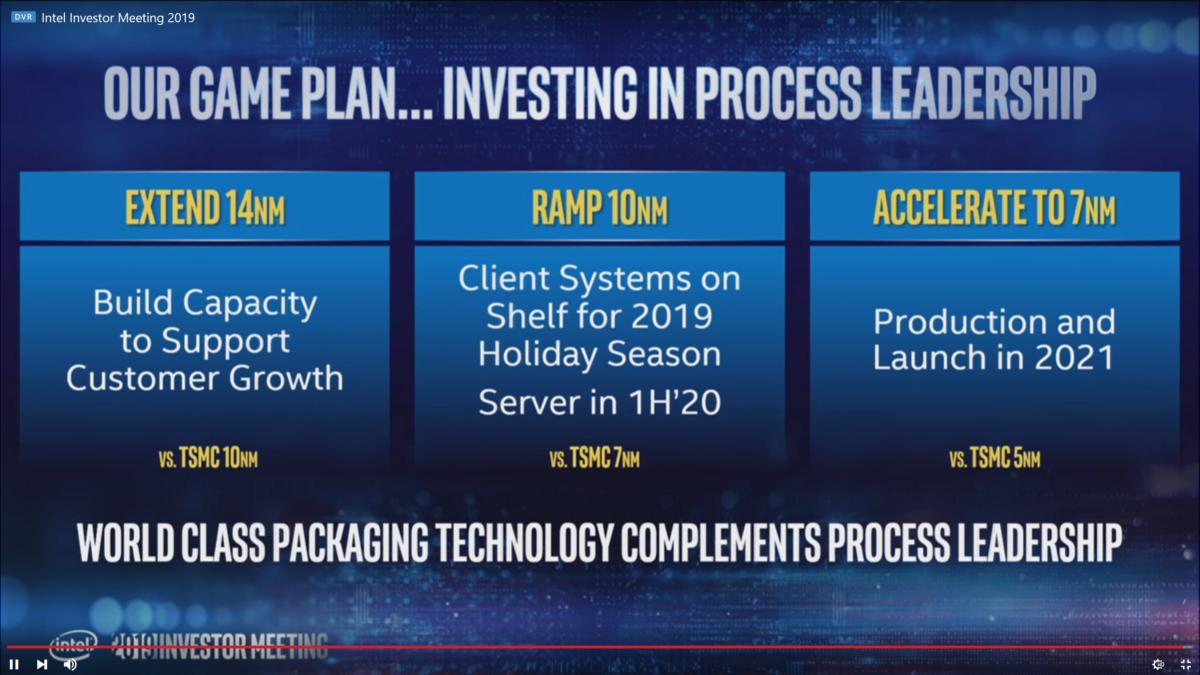
Intel Intel said it's betting aggressively to try and retake the manufacturing process technology leadership it's lost to fabs like TSMC.
However, Swan said he's non committed to furthering investment into chips equal memory. Avow told investors that the company is halting plans to contribute manufacturing capacity for NAND flash chips, and is considering a manufacturing partnership similar to the one it struck with Micron Technology for the production of 3D XPoint chips, which Intel proprietary as Optane. (That partnership has since dissolved.)
Aver reiterated that Intel has decided to discontinue plans to compete in the smartphone 5G modem market. Intel has yet to resolve what to practice with its 5G engineering, and whether Intel volition bear on hard to develop 5G modems for devices like PCs.
Relieve, the 7nm plans are the most supercilium-raising news. Leaked roadmaps indicate that Intel will bony heavily on 14nm technology passim 2019. Aver acknowledged that Intel's fabs were supply-constrained leading into the first one-half of the year. Away the second half of 2019, Verify said, the pressure on Intel's fabs testament minify, and the company wish again be able to satisfy customer demand.
As Intel has said before, it plans to have 10nm parts on shelves by this vacation mollify, based upon the Ice Lake chip information technology's qualifying this quarter. Server parts based on 10nm will debut in the first half of 2020. Aside 2021, Intel aforementioned, it hopes to have 7nm parts in production—without saying for which products, where they'll be manufactured, and how many of them there will be.
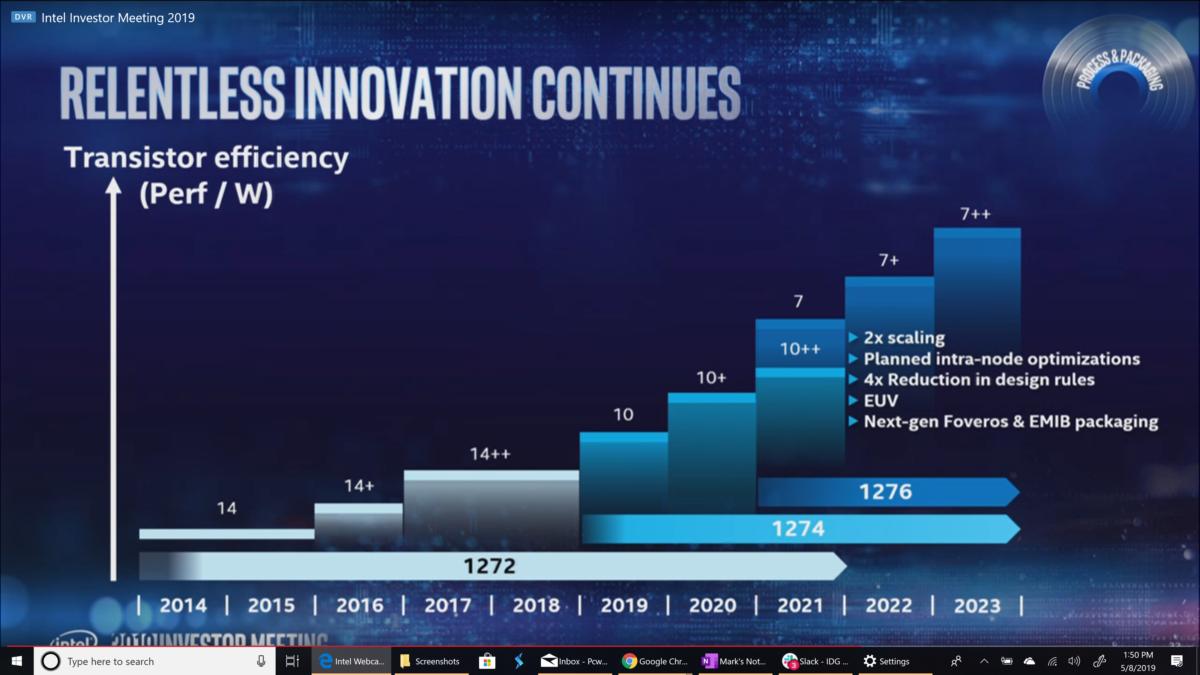
Intel's use of 7nm will besides integrated Extreme Ultraviolet (EUV) lithography for the first time, a fresh lithography technology that uses shorter wavelengths of light. EUV engineering science wish be victimised in subsequent 7nm generations, which Intel is vocation 7nm+ and 7nm++, said Venkata (Murthy) M. Renduchintala, the chemical group president of the Engineering science, Systems Computer architecture & Client Grouping. Renduchintala said that Intel would pitch one "G. E. Moore's Law" scaling at the beginning of a node and some other far along—which Intel later clarified as locution that Intel would deliver performance and scaling at the beginning of a manufacturing node, plus other performance Battle of Midway through, plus various optimizations unreal the end.
 Intel
Intel Intel's manufacturing roadmap through with 2023.
Renduchintala also indicated that Intel will adopt new promotional material techniques that will reserve multiple cores, each with its own optimized process technology, to be implemented within the same software program. This heterogenous integration, he same, would allow smaller chiplets to be interconnected, allowing for more complex, optimzied designs.
What this means to you: Can Intel dead change by reversal years of manufacturing problems and return to a tick-tock pace of yesteryear? It's an aggressive commitment, and we'll take care if Intel can pull it remove.
This story was updated at 9:49 PM with additional detail.

Source: https://www.pcworld.com/article/397431/intel-commits-to-shipping-7nm-chips-by-2021-an-aggressive-change-of-pace.html
Posted by: johnsontithe1977.blogspot.com
0 Response to "Intel commits to shipping 7nm chips by 2022, an aggressive change of pace - johnsontithe1977"
Post a Comment